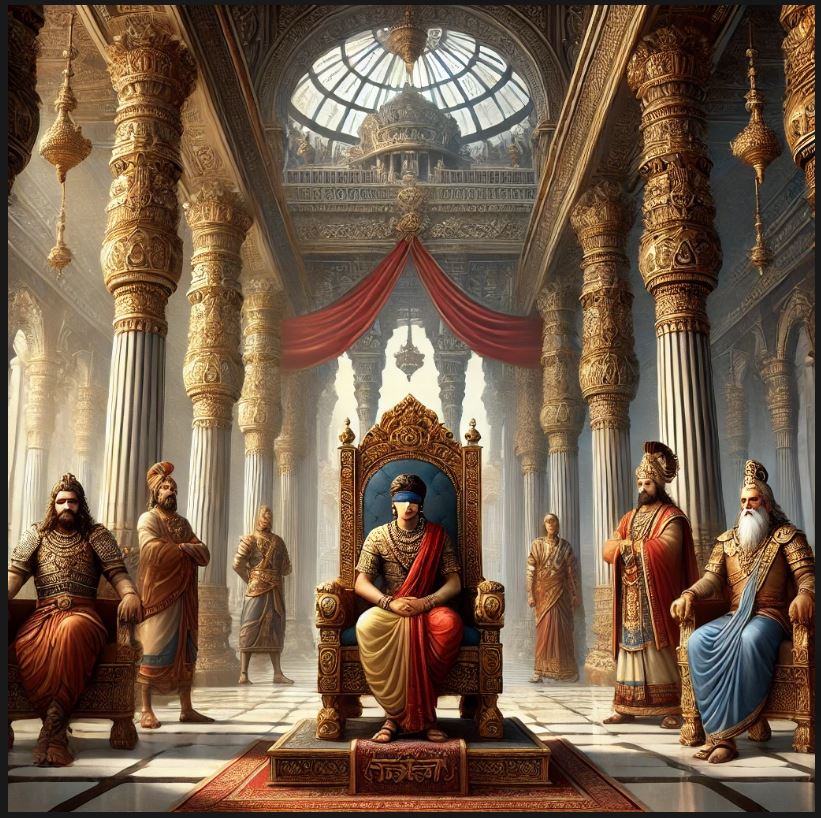
In the vast kingdom of Hastinapura, Dhritarashtra’s tragic story is more than just a tale from a distant age. It is a profound lesson, especially for the times of Kali Yuga—the era of darkness and discord in which the world finds itself now. His blind love for his son Duryodhana did not just destroy a kingdom; it set a timeless warning for families, rulers, and individuals of every era. For just as Dhritarashtra’s misguided attachment led to the downfall of the Kuru dynasty, so too can blind love for one’s children in Kali Yuga ruin not only families but the fabric of society itself.
In the age of Kali Yuga, humanity is foretold to suffer from greed, selfishness, and moral decay. It is an era where, more than ever, parents may be tempted to indulge their children’s every whim, turning a blind eye to their misdeeds, hoping to shield them from the world’s harshness. But in doing so, they often forget that true love is not about protecting from consequences but about guiding toward righteousness, even when it is difficult.
Dhritarashtra’s failure was not in loving Duryodhana—it was in allowing that love to become blind, detached from wisdom and morality. His desire to see his son happy and powerful made him ignore the growing signs of Duryodhana’s arrogance, his unchecked greed, and his resentment towards the Pandavas. This same blindness can be seen in today’s world, where parents often overlook their children’s faults, shielding them from the consequences of their actions, whether it’s in small, everyday matters or grave, life-altering decisions.
In Kali Yuga, a parent’s love can easily turn into overprotection, leading to entitlement and moral blindness in the next generation. Much like Dhritarashtra, when parents refuse to correct their children out of fear of alienating them, they lay the seeds for future chaos. Instead of learning humility, discipline, and empathy, children may grow up believing that the world owes them everything, much like Duryodhana believed the throne was his by birthright, regardless of his actions.
Consider the warning from Dhritarashtra’s story—when parents indulge, excuse, or justify their children’s unethical behavior out of love or pride, they become complicit in that behavior. Dhritarashtra, despite knowing the right path, allowed Duryodhana to follow the wrong one. He had every opportunity to correct his son, to counsel him towards virtue, but he remained passive, letting his blind love override his duty as a father and as a king.
Today’s parents, too, face these critical choices. When a child cheats in school, bullies others, or engages in deceitful practices, do they protect the child from consequences, or do they guide them toward accountability? When the child shows selfishness or greed, do they nurture these traits in the name of love, or do they foster generosity and empathy? The answers to these questions will determine the future of families and, in turn, society.
In Kali Yuga, where moral values are often eroded by the pursuit of material wealth and power, the story of Dhritarashtra’s blind love echoes even louder. Children raised without a moral compass, empowered by indulgence and uncorrected wrongdoing, can become the Duryodhanas of today—individuals who believe they are entitled to anything they desire, regardless of whom they harm. And just as Duryodhana’s unchecked ambition led to the destruction of his entire family, so too can unchecked behaviors in a family today lead to its disintegration.
We see it in broken relationships, strained familial bonds, and societies fragmented by individualism. Parents, in their desire to protect their children from hardships, may shield them from the responsibilities and lessons that hardships bring, creating a generation that lacks the resilience and moral foundation to thrive in a complex world. The family, once the backbone of society, begins to crumble, just as the mighty Kuru dynasty did under Dhritarashtra’s reign.
But the story of Dhritarashtra is also a lesson of hope—that love, when combined with wisdom and righteousness, can save a family from destruction. If Dhritarashtra had balanced his love for Duryodhana with his duty as a father and king, the Kurukshetra War might have been avoided, and the Kuru dynasty might have flourished. Similarly, in Kali Yuga, families can thrive when love is paired with discipline, when affection is tempered by moral guidance, and when indulgence is replaced by responsibility.
In the end, the downfall of the Kuru dynasty serves as an eternal reminder that blind love, no matter how deep or well-intentioned, can lead to ruin if it is not rooted in truth and dharma. Dhritarashtra’s mistake was not loving his son—it was loving him at the expense of righteousness, justice, and the well-being of the entire family. Today, in Kali Yuga, it is the duty of parents, guardians, and leaders to learn from this story, ensuring that love for one’s children or kin does not become the very force that brings about their destruction.
For the family, when built on a foundation of moral strength and guided love, can withstand the tests of time—even in the darkest age. But when love turns blind, it becomes a force of ruin, just as it did for Dhritarashtra and the Kauravas.
Leave a Reply